



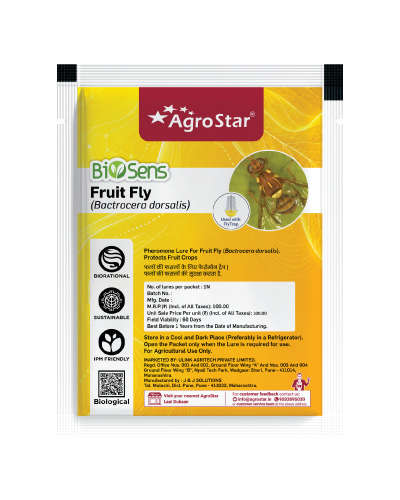
Biosens Fruit Fly (Bactrocera dorsalis) Lure 1 Unit
₹36₹100
( 64% OFF )price per unitInclusive of all taxes
Proper advice from Agri doctor on every problem of crop

100% Original Product with Free Home Delivery

Do crop planning with accurate weather information
Farming updates, schemes and plans through Krishi gyan video

60 lakh farmers trust Agrostar

Key Points
Biosens Fruit Fly Lure attracts male Oriental fruit flies and related species into the Fly Trap. With fewer males in the orchard, fewer eggs are laid and fewer maggots damage mango, guava and other fruits. One lure works for up to 60 days.
Target PestOriental fruit fly (Bactrocera dorsalis), peach fruit fly (B. zonata) and guava fruit fly (B. correcta). The lure attracts adult male flies.
Compatible TrapFly Trap
Field ViabilityUp to 60 days, depending on weather. The lure starts attracting flies within 2 days of placement. For best results, replace it after 60 days.
Applicable cropsMango, guava, sapota, papaya, banana, citrus, apple and peach. For gourds, melons and cucumber, use Biosens Melon Fly Lure.
Method of applicationPlace one lure in the holder basket of the Fly Trap, with a little water and a few drops of edible oil at the bottom. Hang the traps on tree branches or stakes, 3-5 ft above the ground in partial shade, spread evenly across the orchard.
Extra descriptionFruit flies are among the most damaging pests of mango, guava and many other fruits. The female fly lays eggs under the skin of maturing fruits. The maggots feed inside, and the fruit softens, rots and often drops early. A fruit can look healthy outside and still carry maggots, so the damage often shows only at harvest or in storage. The maggots then drop to the soil to turn into pupae, and a single female can lay hundreds of eggs, so numbers build up fast as the fruits ripen. Sprays give limited control because the maggots stay protected inside the fruit. Biosens Fruit Fly Lure acts on the adult flies, before the next round of eggs is laid. It draws male flies into the Fly Trap, where they drown in the water at the bottom. Use it in two ways: • Monitoring: the traps show when fruit flies arrive and how fast their numbers are rising, so control measures can be planned at the right time. • Mass trapping: a larger number of traps removes many males from the orchard. Fewer females get mated, fewer eggs are laid and fewer maggots reach the fruits. Used from fruit development till harvest, together with collection of fallen fruits, it reduces fruit fly build-up and fruit damage, lowers the need for insecticide sprays and gives more healthy, marketable fruits.
Dosage• 1 lure per trap • Monitoring: 8-10 traps per acre • Mass trapping: 15-30 traps per acre • Install the traps when the fruits start to develop, at least 45 days before harvest, and keep them till the last picking.
Mode of actionMale fruit flies are naturally drawn to a compound found in many plants, which they feed on and use to attract females. Biosens Fruit Fly Lure releases this male attractant, called a para-pheromone, at a slow, steady rate. Male flies come to the trap from far away, enter it and drown in the water at the bottom. Female flies do not respond to the lure, so only males are caught. With fewer males left in the orchard, many females stay unmated and fewer eggs are laid in the fruits. This method is known as male annihilation. The lure is specific to fruit flies and does not harm bees or natural enemies.
Directions to Use1. Open the lure pouch only at the time of use. Place the lure in the holder basket inside the Fly Trap. 2. Pour about 100 ml of water with a few drops of edible oil into the bottom of the trap. Make sure the lure does not touch the water. 3. Fix the top cap onto the trap body until it locks in place. 4. Hang the trap on a tree branch or stake, 3 to 5 ft above the ground in partial shade. 5. Spread the traps evenly across the orchard as per the dosage. 6. Check the traps regularly. When a trap fills with flies, open the top, empty it, add fresh water and oil, and lock it again. 7. Every week, collect fallen and damaged fruits and destroy them by burying them deep in a pit or sealing them in a plastic bag. This kills the maggots inside and works well with the traps. 8. For monitoring, count the flies caught at each check and write the number down. If catches keep rising, check the fruits for egg-laying marks and plan control measures. 9. Replace the lure after 60 days.
Benefits• Gives early warning of fruit fly attack, so control measures can be timed right. • Removes male flies before they mate, which cuts egg laying in the fruits. • Acts on the adult flies, before the maggots get inside the fruits where sprays cannot reach them. • Reduces the need for chemical insecticide sprays and fits well into Integrated Pest Management (IPM). • Protects fruits from maggot damage and rot, giving more healthy, marketable produce. • Leaves no residue on the fruits, as the lure stays inside the trap and is never sprayed on the crop. • Specific to fruit flies. Safe for bees, natural enemies and the environment. • Easy to use: no mixing or spraying, and one lure lasts up to 60 days.
Special remarks• Use the lure only in the Fly Trap. • Open the pouch just before placing the lure in the trap and use the lure immediately. • Avoid touching the lure with bare hands, and wash your hands after handling it. Do not handle lures of different pests together, as their scents can mix and reduce catches. • Keep the lure out of the water in the trap and away from chemicals. Do not mix it with pesticides or fertilizers, and do not spray anything on the trap or lure. • Store unused lures in their sealed pouches in a cool, dry place, away from direct sunlight. • Shelf life: 12 months from the date of manufacture. • Dispose of used lures and trapped flies away from the field, as used lures still give off some scent. • Lure performance and field life may vary with temperature, wind and rain. • Keep lures away from children, pets, food and animal feed.
