



Advisory ArticleAgroStar Agronomy Centre of Excellence
Management of dry sugarcane leaves
Balanced use of chemical and organic fertilizers is necessary for more growth of crops. It is the call of the hour to give organic fertilizers to the farm. Recently as the area under irrigation has increased, the use of chemical fertilizers has also increased. In addition to that there is lack of availability of FYM compost. So this need has to be fulfilled by green manures.
Availability of dry leaves:
After the sugarcane is harvested, its dry leaves remain in the farm. Generally 7.5 to 10 tons of dry leaves are available from one hectare of farm. From this, we can get 4 to 5 tons of organic manure.
Benefits of dry leaves:
• No need to give another organic manure since you get 4 to 5 tons of organic manure from dry leaves.
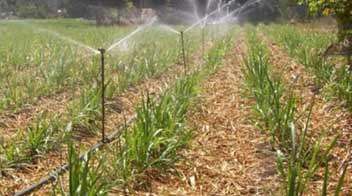
• Mulching of the dry leaves saves water.
• The weeds do not grow because of dry leaves.
• The expenses on green manure and FYM are saved.
Drawbacks of burning the dry leaves -
• When dry leaves are burnt, nutrients like organic carbon, nitrogen, phosphorus and potash are destroyed.
• As the land is burnt, the number of bacteria in the soils decrease.
• Due to burning of dry leaves, 100% nitrogen and 75% other components get destroyed.
Organic manure production from dry leaves in ratoon crop -
After the cultivated sugarcane is harvested, for the ratoon crop, the stumps in ridge should be separated by hand and should be pressed in the furrows. For vigourous buds, the stumps should be cut with a sickle and then 10 gm Bavistin in 10 liters of water should be sprayed immediately. There is 1 ton of dry leaves in every 10 guntha area in the farm. For this one ton of dry leaves, 8 kg urea, 10 kg single super phosphate should be spread on the dry leaves and then 1 kg decomposing bacteria should be mixed in dung slurry and sprayed on the dry leaves. After that, first watering should be done. This should be done after sugarcane is harvested. After 3-4 days, the first dose of fertilizer should be given at 15 cm distance from the stem and at 15 cm depth and by keeping distance between two holes as 30 cms. The second dose should be given on the opposite side of the furrow after 135 days. And water should be given as usual. If the dry leaves are managed in this way in the ratoon crop, it helps as a mulching initially and decreases evaporation and saves irrigation. Later organic manure gets created.
210
0