



Insect Life CycleAgroStar Agronomy Centre of Excellence
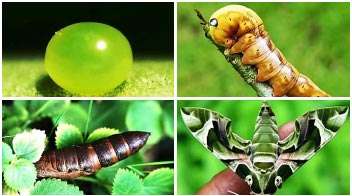
Life Cycle OF Hawk Moth
Hawk moths lay eggs under the leaf of the vine. The larvae have their own polymorphism starting from black or grey with dark lines on the backside. They turn green as they mature. The posterior end of the abdomen of the horn is an S- shaped structure, serving as a defensive organ. When annoyed, the back of the larvae can regurgitate the green fluid._x000D_
Host crops: The hawk moth are the polyphagous insect pest, which causes damage to Oilseeds like Sesame, Pulses like green gram and Oleander._x000D_
Damage Symptoms: Caterpillars feed on the leaves and defoliate the plant._x000D_
The female moth lays up to 100 or more eggs in a season._x000D_
Egg: Eggs are laid singly on the underside of leaves._x000D_
Larvae: The early instar (the larval stage between two moults) larvae are also found on the undersurface of leaves while the older larvae camouflage themselves on stems._x000D_
Pupa: When the larvae are about to pupate, they move down to the leaf bed where the cocoon or cell on the surface of the soil is hard. Any larvae travel deeper into the soil and pupate in the earth cocoon below the surface of the soil. The pupal period lasts from around 1 to 25 weeks._x000D_
Moth: The adult moth has been existing for many weeks and has to eat daily, mate and lay eggs for the next generation. Females lure males using pheromones (chemicals)._x000D_
Management: Hand-picking of caterpillars and destroying them._x000D_
_x000D_
Source: Australian Museum and AgroStar Agronomy Centre of Excellence_x000D_
_x000D_
If you like this information Like and Share it with your farmer friends._x000D_
_x000D_
212
0